
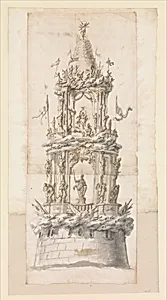
Design for a Temporary Structure for a Festival Celebration
Medium
Pen and brown ink, brush and gray wash
Dimensions
27-5/8 x 11-1/4 in. (70.2 x 28.6 cm); composed of two sheets, joined two-thirds from top.
Classification
Drawings|Ornament & Architecture
Department
Drawings and Prints
Museum
Metropolitan Museum of Art, New York, NY
Credit
Purchase, Harris Brisbane Dick Fund and Joseph Pulitzer Bequest, 1971
Accession Number
1971.513.11
Rights
Public Domain
Tags
Art Historical Context
In the vibrant world of 18th-century, grand festivals like Carnival or religious feasts transformed city streets into theaters of spectacle. This anonymous drawing, created between 1700 and 1735, presents a meticulous design for a temporary tower-like structure, likely intended for such celebrations. These ephemeral architectures—adorned with sculptures, banners, and illuminations—served as focal points for parades and fireworks, embodying the Baroque era's love for drama and public pomp. Joined from two large sheets (27-5/8 x 11-1/4 inches), the composition hints at the ambitious scale of these festive installations, now preserved as a rare glimpse into Roman urban revelry. Executed in pen and brown ink with brush and gray wash, the work showcases precise linework for structural details alongside subtle shading to convey volume and light. This technique, standard for architectural drawings of the period, allowed designers to communicate complex ornamentation to builders and patrons efficiently. Housed in the Metropolitan Museum of Art's Drawings and Prints department, it highlights the intersection of architecture and ornament in Italy's festive traditions, where art blurred into everyday spectacle. Visitors today can appreciate how such designs fueled Rome's cultural heartbeat, blending engineering ingenuity with theatrical flair.