
Design for a Textile
Classification
textile designs
Department
Smithsonian Collection
Museum
Smithsonian American Art Museum
Credit
Museum purchase from Friends of the Museum Fund
Accession Number
1957-46-19
Rights
Public Domain
About this artwork
Research in Progress
Art Historical Context
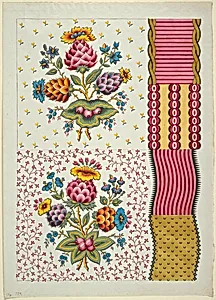
Step into the world of early 19th-century Swiss textile innovation with *Design for a Textile* by Louis-Albert DuB (1752–1818). A skilled engraver and designer from Switzerland, DuBois created this work around 1801, capturing the elegance of the Neoclassical era just as the Napoleonic influences began shaping European aesthetics. Housed in the Smithsonian American Art Museum's collection this piece reflects the artist's expertise in crafting patterns for printed fabrics, a craft that blended artistry with industrial precision. Switzerland's textile industry, particularly in regions like Neuchâtel where DuBois worked, was a global powerhouse at the turn of the century. Designers like him produced intricate copperplate engravings that enabled vibrant, repeatable patterns on cotton and linen, fueling exports to Europe and beyond—including America. Though the exact medium remains under study (research in progress), such designs were pivotal in democratizing luxury motifs, from florals to geometric forms, making fine art accessible through everyday textiles. This acquisition, made possible by the Friends of the Museum Fund, highlights the Smithsonian's commitment to preserving these unsung gems of design history. DuBois's work reminds us how textiles wove commerce, culture, and creativity together, bridging Old World craftsmanship with emerging modern industry. (198 words)