
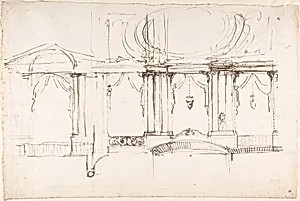
Design for a Theater Interior
1700–1773
Medium
Pen and brown ink over freehand graphite and ruled construction lines in graphite
Dimensions
11-1/4 x 17-1/16 in. (28.5 x 43.3 cm)
Classification
Drawings
Department
Drawings and Prints
Museum
Metropolitan Museum of Art, New York, NY
Credit
Gift of Donald Oenslager, 1965
Accession Number
65.536.1
Rights
Public Domain
Tags
Art Historical Context
Luigi Vanvitelli’s *Design for a Theater Interior* offers a fascinating glimpse into 18th-century architectural planning. Created during the artist’s lifetime (1700–1773), this drawing reflects the period’s growing enthusiasm for grand public theaters across Europe, especially in Italy, where opera and spectacle flourished under royal patronage. Vanvitelli, best known for his work on the Royal Palace of Caserta, brought his expertise in grand-scale design to such projects, blending functionality with dramatic visual impact. The medium—pen and brown ink over freehand graphite and ruled construction lines—reveals the careful process behind theatrical architecture. Visible guidelines and adjustments show how Vanvitelli balanced sightlines, acoustics, and ornate decoration, elements essential to an immersive audience experience. As a preparatory study rather than a finished rendering, the sheet underscores the meticulous thought required to transform empty space into a vibrant cultural venue. Housed in the Metropolitan Museum of Art’s Department of Drawings and Prints, this work highlights Vanvitelli’s lasting influence on neoclassical design. Its gift by Donald Oenslager, a noted theater historian, further connects the drawing to ongoing appreciation for historic stagecraft and interior architecture.
About the Artist
Luigi Vanvitelli · 1700–1773
Born 12 May 1700; died 1 March 1773. Famous for his design for the Royal Palace at Caserta, built 1751. Vanvitelli was active in Rome, Naples and nearby towns, also Brescia, Milan and Genoa. Comment on works: Portraits