
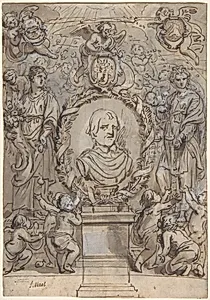
Design for a Title Page
17th century
Medium
Pen and brown ink, black chalk, brown wash, white gouache; Verso: rubbed with black chalk for transfer.
Dimensions
11 9/16 x 7 15/16 in. (29.3 x 20.2 cm)
Classification
Drawings
Department
Drawings and Prints
Museum
Metropolitan Museum of Art, New York, NY
Credit
The Elisha Whittelsey Collection, The Elisha Whittelsey Fund, 1960
Accession Number
60.186
Rights
Public Domain
Tags
Art Historical Context
Abraham van Diepenbeeck's *Design for a Title Page*, created in the 17th century, exemplifies the ornate preparatory drawings favored by Flemish Baroque artists. A versatile painter, engraver, and miniaturist who collaborated with Peter Paul Rubens, Diepenbeeck crafted this sheet as a blueprint for a printed book title page, featuring portraits of men adorned with wreaths and a prominent coat of arms—hallmarks of heraldic splendor that conveyed status and prestige in an era of expanding print culture. Rendered in pen and brown ink with black chalk, brown wash, and white gouache, the drawing showcases meticulous Baroque techniques for texture and depth. Highlights pop against shadowed areas, while the verso, rubbed with black chalk, reveals its practical use for transfer: artists pressed it against another surface to outline the design for engraving, streamlining book production amid Europe's scholarly publishing boom. Housed in the Metropolitan Museum of Art's Drawings and Prints department, this 11 9/16 x 7 15/16-inch work highlights the fusion of artistry and utility in 17th-century workshops, where such designs elevated books from mere texts to visual treasures celebrating nobility and learning.