
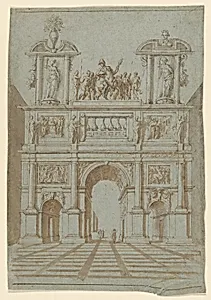
Design for a Triumphal Arch in Perspectival Rendering
ca. 1600–1630
Medium
Pen and brown ink, brush and brown wash
Dimensions
Sheet: 11 3/8 × 7 3/4 in. (28.9 × 19.7 cm)
Classification
Drawings|Ornament & Architecture
Department
Drawings and Prints
Museum
Metropolitan Museum of Art, New York, NY
Credit
Edward Pearce Casey Fund, 2013
Accession Number
2013.929
Rights
Public Domain
Tags
About this artwork
This architectural design presents a triumphal arch rendered in sophisticated perspectival projection, demonstrating the intersection of classical architectural vocabulary with emerging Renaissance and Baroque spatial representation techniques. Attributed to the circle of Inigo Jones, the great English architect who revolutionized British architecture through his introduction of Italian Renaissance principles, this early seventeenth-century drawing exemplifies the period's interest in monumental...
Art Historical Context
This exquisite drawing, *Design for a Triumphal Arch in Perspectival Rendering*, from the circle of In Jones, the pioneering British architect who brought Italian Renaissance principles to England in the early 17th century. around 1600–1630 pen and brown ink with brush and brown wash on modest 11⅜ × 7¾-inch sheet, it captures a grand triumphal arch in sophisticated perspective. Such techniques blended classical Roman vocabulary—think sturdy columns and entablatures—with emerging Baroque spatial depth, showcasing the era's fusion of ancient grandeur and innovative projection. Triumphal arches like this were temporary spectacles for royal entries, coronations, and state events, transforming city streets into stages of monarchical power and civic pride. Jones, inspired by Andrea Palladio's treatises on proportion and orders, oversaw workshops that produced these designs with the precision of permanent buildings. Whether a patron presentation or construction guide, it highlights collaborative architectural practice. Surviving drawings of these ephemeral structures are rare treasures, preserving the theatrical flair of early modern England's ceremonial culture. At the Metropolitan Museum of Art, this piece offers a window into how architecture served politics and pageantry.