
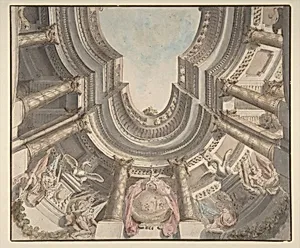
Design for a Trompe L'Oeil Ceiling
ca. 1750–60
Medium
Pen and brown ink, brush and brown, gray, rose, green and blue wash, over traces of black chalk or leadpoint
Dimensions
9 15/16 x 11 7/8 in. (25.3 x 30.1 cm)
Classification
Drawings|Ornament & Architecture
Department
Drawings and Prints
Museum
Metropolitan Museum of Art, New York, NY
Credit
Purchase, Harris Brisbane Dick Fund and Joseph Pulitzer Bequest, 1971
Accession Number
1971.513.55
Rights
Public Domain
Tags
Art Historical Context
Step into the enchanting world of 18th-century Italian illusionism with Flaminio Innocenzozzi's *Design for a Trom L'Oeil Ceiling* (ca. 1750–60). As an architect and designer active in theoco era, Minozzi in quadratura—the architectural perspective that makes flat surfaces appear three-dimensional. This preparatory drawingvisions a ceiling alive with birds and angels, crafted to deceive the eye (*trompe l'oeil*) and transport viewers into a celestial realm, much like the opulent frescoes adorning palaces and churches across Europe. Executed on a modest sheet measuring 9 15/16 x 11 7/8 inches, the work employs pen and brown ink for precise lines, layered with brush washes in brown, gray, rose, green, and blue over faint black chalk underdrawing. These techniques allowed Minozzi to model forms with subtle color and shadow, simulating stone vaults, fluttering wings, and ethereal figures—hallmarks of Baroque and Rococo decorative schemes that blurred art and architecture. Acquired by The Metropolitan Museum of Art in 1971 through the Harris Brisbane Dick Fund and Joseph Pulitzer Bequest, this gem from the Drawings and Prints department reveals the meticulous planning behind grand illusions. It captures the era's passion for spectacle, inviting us to imagine gazing upward in awe at a painted heaven come to life.