
Design for a Vignette: Harbor Scene
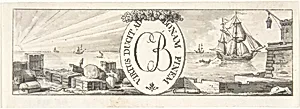
Medium
Pen and black ink with brush and gray wash
Dimensions
1 1/4 x 3 3/8 in. (3.1 x 8.6 cm)
Classification
Drawings
Department
Drawings and Prints
Museum
Metropolitan Museum of Art, New York, NY
Credit
Gift of Lincoln Kirstein, 1965
Accession Number
65.717.1
Rights
Public Domain
Tags
Art Historical Context
Nestled among the treasures of the Metropolitan Museum of's Drawings and Prints department, *Design for a Vignette Harbor Scene* by Charles Percier captures the elegance of early 19th-century French design in a remarkably compact form—measuring just 1 1/4 x 3 3/8 inches. Percier, a leading neoclassical architect and decorator famed for his collaborations with Pierre Fontaine on Napoleonic interiors, here turns his precise hand to a vignette: a delicate, self-contained illustration often used to adorn book pages or decorative prints. Rendered in pen and black ink with subtle brush and gray wash, the tiny scene evokes a bustling harbor alive with ships, their sails billowing against a hazy seascape. This drawing exemplifies the Empire style's blend of classical restraint and romantic detail, showcasing Percer's mastery of line work to suggest depth and atmosphere in limited space. Vignettes like this were prized for their ornamental versatility, bridging architecture and graphic arts during France's revolutionary era. The gray wash adds a luminous, atmospheric quality, mimicking the play of light on water—a technique that highlights his innovative approach to small-scale design. Generously gifted by Lincoln Kirstein in 1965, this gem invites visitors to appreciate how everyday motifs like ships could inspire grand imperial aesthetics. Though its exact date remains a mystery, it whispers of an age when art seamlessly wove utility and beauty.
About the Artist
Charles Percier · 1764–1838
Charles Percier (1764–1838) rose from humble origins in Paris, where his mother laundered for Marie-Antoinette and his father served as a porter at the Tuileries Palace, to become one of France's most influential neoclassical architects and designers. From age twelve, he attended a free drawing school for indigent students, honing his skills in the studio of painter Louis-Jean-François Lagrenée be...