
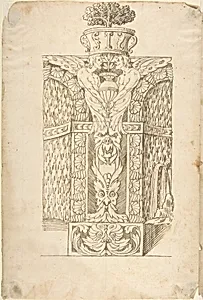
Design for a Wall Fountain
Medium
Pen and brown ink, brush and light brown wash, over leadpoint, with ruled construction and framing outlines
Dimensions
14 5/8 x 9 3/4 in. (37.2 x 24.8 cm)
Classification
Drawings
Department
Drawings and Prints
Museum
Metropolitan Museum of Art, New York, NY
Credit
Purchase, Joseph Pulitzer Bequest, 1965
Accession Number
65.653.17
Rights
Public Domain
Tags
Art Historical Context
This exquisite *Design for a Wall Fountain hails from the vibrant Lombard school of 16th-century Italy (ca. 1550–1620), a region renowned for its fusion of Renaissance elegance and classical motifs. Created by an anonymous artist, it captures the era's fascination with grand garden architecture, where wall fountains served as both functional water features and ornate centerpieces in villas and palazzos. The drawing reflects Lombardy’s tradition of precise, decorative designs inspired by antiquity, blending utility with artistic flourish. Rendered in pen and brown ink with brush and light brown wash over leadpoint underdrawing, the work showcases meticulous Renaissance draftsmanship. Ruled construction lines ensure architectural accuracy, while the subtle wash adds depth and shadow, evoking the fountain's three-dimensional form. Prominent palmettes—fan-shaped, palm-like ornaments—adorn the design, a nod to ancient Greco-Roman decoration revived during the Renaissance to symbolize vitality and harmony. As a preparatory study from The Metropolitan Museum of Art’s Drawings and Prints collection, this piece offers a window into the creative process behind Italy’s lavish outdoor spaces. Acquired through the Joseph Pulitzer Bequest in 1965, it reminds us how such sketches brought imagined splendor to life, gracing the gardens of the elite. (198 words)