
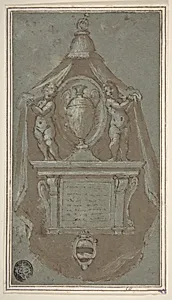
Design for a Wall Tomb
1590–1610
Medium
Pen and brown ink, brush and brown wash, highlighted with white gouache, one blue-green paper.
Dimensions
8 13/16 x 4 13/16 in. (22.4 x 12.3 cm)
Classification
Drawings|Ornament & Architecture
Department
Drawings and Prints
Museum
Metropolitan Museum of Art, New York, NY
Credit
The Elisha Whittelsey Collection, The Elisha Whittelsey Fund, 1952
Accession Number
52.570.156
Rights
Public Domain
Tags
Art Historical Context
Avanzino Nucci, a Mannerist artist from Gubb active in Rome during the late 16th early 17th centuries, this intricate *Design for a Wall Tomb around 1590–1610. Rendered on striking blue-green paper, the drawing exemplifies the preparatory sketches used by architects and designers of the period to plan elaborate funerary monuments for churches. Such wall tombs were commissioned by noble families or clergy to commemorate the deceased, blending architecture, sculpture, and heraldry in a display of piety and status. The composition likely features symbolic children—possibly cherubs or representations of the departed young—and a prominent coat of arms, evoking themes of innocence, lineage, and eternal rest. Nucci precise pen and brown ink for outlines, layered with brush and brown wash for tonal depth, and heightened with white gouache to mimic sculptural relief against the tinted paper. This mixed-media technique, common in Renaissance workshops, allowed artists to simulate three-dimensionality and stone carving effects efficiently. Housed in the Metropolitan Museum of Art's Drawings and Prints department, this modest yet masterful sheet (8 13/16 x 4 13/16 in.) offers a window into the collaborative world of Italian design during the transition from Mannerism to Baroque grandeur, where ornamentation served both spiritual and social purposes.