
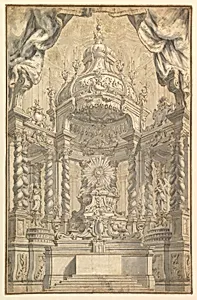
Design for Altar Decorations for a Liturgical Celebration
Medium
Pen and brown ink, brush with gray and brown wash, partially laid down on blue paper
Dimensions
20 x 13-5/8 in. (50.8 x 34.6 cm)
Classification
Drawings
Department
Drawings and Prints
Museum
Metropolitan Museum of Art, New York, NY
Credit
The Elisha Whittelsey Collection, The Elisha Whittelsey Fund, 1954
Accession Number
54.586
Rights
Public Domain
Tags
Art Historical Context
This exquisite anonymous drawing from 18th-century Piedmont, Italy, offers a glimpse into the opulent world of liturgical celebrations. Titled *Design for Altar Decorations a Liturgical Celebration*, dates to 1750–75 and depicts elaborate schemes for adorning church altars during sacred feasts. In Piedmont, a region blending Savoyard grandeur with Italian Baroque traditions, such designs elevated religious rituals, transforming altars into dramatic focal points with scrolling motifs, architectural frames, and symbolic flourishes that evoked heavenly splendor. Crafted in pen and brown ink with brush-applied gray and brown washes on blue paper, the work exemplifies preparatory techniques of the era. The blue ground—partially visible as the sheet is laid down—serves as a clever mid-tone, allowing artists to heighten shadows with darker washes and reserve highlights for luminous effect. This monochromatic palette, common in Italian draftsmanship, enabled precise planning for costly executions in stucco, gilt, or fresco. Housed in the Metropolitan Museum of Art's Drawings and Prints department, this 20 x 13⅝-inch sheet (from The Elisha Whittelsey Collection) captures the artistry behind Italy's enduring ecclesiastical heritage. It reminds us how anonymous craftsmen shaped the sensory power of worship, bridging devotion and decoration in the Rococo twilight of the Baroque age.