
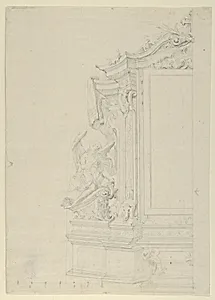
Design for an altar
Medium
Graphite
Dimensions
Sheet: 11 1/8 x 7 15/16 in. (28.3 x 20.2 cm)
Classification
Drawings|Ornament & Architecture
Department
Drawings and Prints
Museum
Metropolitan Museum of Art, New York, NY
Credit
The Elisha Whittelsey Collection, The Elisha Whittelsey Fund, 1948
Accession Number
48.91.9
Rights
Public Domain
Art Historical Context
This delicate graphite drawing, titled *Design for an Altar*, to the early 18 century and exemplifies the ornate architectural sketches produced across Europe during the Baroque era Attributed variously to an anonymous German artist, Daniel Marot the Elder—a renowned French-Dutch designer known for his lavish Protestant interiors—or an anonymous Bolognese Italian from the same period, it captures the grandeur of ecclesiastical design. At just 11 1/8 x 7 15/16 inches, the sheet served as a preparatory study, likely intended for a church altar adorned with intricate columns, pediments, and sculptural motifs that evoke the dramatic theatricality of Baroque ornamentation. Graphite, a versatile medium favored by architects and designers for its precision and subtle tonal range, allowed the artist to render fine details and shadows with remarkable clarity—essential for conveying three-dimensionality on a flat surface. Such drawings were vital tools in workshops, bridging imagination and execution in an age when altars symbolized faith's opulence amid the Catholic Counter-Reformation and Protestant refinements. Housed in the Metropolitan Museum of Art's Drawings and Prints department through The Elisha Whittelsey Collection (1948), this work offers a window into 18th-century collaborative artistry, highlighting how regional styles—from Germany's robust forms to Italy's elegant curves—influenced sacred spaces. A testament to the era's fusion of piety and splendor, it invites visitors to appreciate the unseen labor behind Europe's lavish churches.