
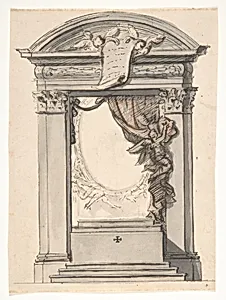
Design for an altar
late 17th–early 18th century
Medium
Pen and black ink, gray and red wash, over black chalk or graphite
Dimensions
sheet: 6 1/2 x 5 1/16 in. (16.5 x 12.8 cm)
Classification
Drawings
Department
Drawings and Prints
Museum
Metropolitan Museum of Art, New York, NY
Credit
Purchase, Charles and Jessie Price Gift, 2010
Accession Number
2010.102
Rights
Public Domain
Tags
Art Historical Context
This delicate drawing, created in the late 17th or early 18th century, captures a preparatory for an elaborate altar, reflecting the rich tradition of Flemish Baroque religious art. Attributed to the circle of Antwerp sculptors Hendrik-Frans Verbruggen and Michiel van der Voort, along with an anonymous Flemish draftsman, the sheet likely served as a working study for a church commission. During this period, Southern Netherlandish artists produced ornate altarpieces to inspire devotion in the wake of the Counter-Reformation, blending sculpture, architecture, and painting into dramatic ensembles. Executed in pen and black ink with gray and red washes over chalk, the medium allows for both precise linear detail and subtle tonal modeling, techniques essential for conveying the three-dimensional effects of carved wood or stone. The compact scale—roughly postcard-sized—suggests it was intended for close examination by patrons or workshop assistants rather than public display. Such designs highlight the collaborative nature of Baroque altar production, where sculptors like Verbruggen, renowned for dynamic figural groups, translated two-dimensional ideas into monumental works. Acquired by the Metropolitan Museum of Art in 2010, this drawing offers valuable insight into the creative process behind Flemish ecclesiastical furnishings, preserving a fleeting glimpse of how grand religious spaces were envisioned and realized.