
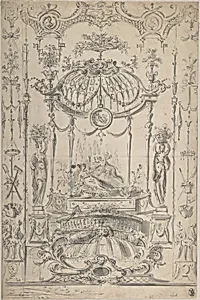
Design for an Arabesque with Cupid and Psyche
1720–40
Medium
Pen and gray ink, brush and gray wash
Dimensions
12 1/2 x 8 5/16 in. (31.8 x 21.1 cm)
Classification
Drawings|Ornament & Architecture
Department
Drawings and Prints
Museum
Metropolitan Museum of Art, New York, NY
Credit
Purchase, Harris Brisbane Dick Fund and Joseph Pulitzer Bequest, 1971
Accession Number
1971.513.38
Rights
Public Domain
Tags
Art Historical Context
This delicate drawing by Claude Gillot captures the elegance of early eighteenth-century French design. Created between 1720 and 1740, the work is a preparatory study for an arabesque—a graceful ornamental motif of scrolling vines, tendrils, and fantastical figures that became a hallmark of Rococo decoration. Gillot, a pioneering draftsman and theatrical designer, helped shape this light, playful style that would influence artists such as Antoine Watteau. Executed in pen and gray ink with subtle washes, the sheet demonstrates his precise line work and sensitivity to tonal effects, qualities that made such designs ideal models for tapestries, wall panels, or furniture ornament. At the center of the composition appear the mythological lovers Cupid and Psyche, their story drawn from classical literature and frequently reinterpreted in French art as an allegory of love conquering adversity. Here they are integrated into the flowing arabesque rather than treated as a narrative scene, reflecting the period’s preference for decorative harmony over storytelling. The vertical format and architectural classification suggest the design may have been intended for a narrow panel or decorative border. Acquired by the Metropolitan Museum in 1971, the drawing offers visitors a rare glimpse into the creative process behind Rococo interiors. Its restrained palette and rhythmic lines reveal how artists like Gillot transformed ancient myths into sophisticated patterns that once adorned the salons of Paris.
About the Artist
Claude Gillot · 1673–1722
Artist known for his elegant designs done in the Rococo manner of Audran; also for his predilection for scenes from the 'comedia dell'arte.' Few paintings survive; his work is known mainly through drawings and etchings. Comment on works: Genre; History