
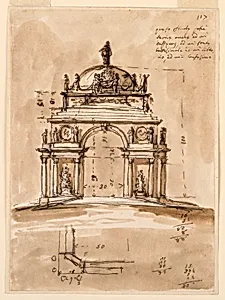
Design for an architectural structure
Classification
architecture
Department
Smithsonian Collection
Museum
Smithsonian American Art Museum
Credit
Museum purchase through gift of various donors and from Eleanor G. Hewitt Fund
Accession Number
1938-88-1200
Rights
Public Domain
About this artwork
Research in Progress
Art Historical Context
Giuseppe Barberi (1746–1809), a prominent Italian architect and designer active in Rome during the late Enlightenment, created this *Design for an Architectural Structure* around 1790. Working in the neoclassical era, Barberi was renowned for his precise, elegant drawings that blended ancient Roman grandeur with contemporary functionality. This piece, classified as architecture within the Smithsonian American Art Museum's collection, exemplifies the preparatory sketches that architects used to propose grand public or ecclesiastical buildings, showcasing Barberi's mastery of proportion and ornamentation. At a time when Europe was rediscovering classical antiquity through excavations at Pompeii and Herculaneum, Barberi's designs contributed to the neoclassical movement's emphasis on symmetry, columns, and pediments. Though the medium remains unidentified amid ongoing research, such works were typically pen-and-ink or watercolor on paper, allowing for detailed renderings that could be scaled into real structures. Acquired through museum purchase with support from donors and the Eleanor G. Hewitt Fund, it highlights the Smithsonian's commitment to preserving European influences on American design traditions. This artifact invites visitors to ponder how Barberi's visionary lines bridged Italy's imperial past with the architectural ambitions of the Revolutionary age, offering a window into the creative process behind enduring edifices. (198 words)