
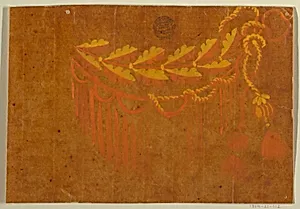
Design for an Embroidered Horizontal Border of the "Fabrique de St. Ruf"
1800–1825
Medium
Drawing
Classification
Drawing
Department
Smithsonian Collection
Museum
Smithsonian American Art Museum
Credit
Gift of Eleanor and Sarah Hewitt
Accession Number
1914-21-112
Rights
Public Domain
About this artwork
Research in Progress
Art Historical Context
This delicate drawing, titled *Design for an Embro Horizontal Border of the "rique de St. Ruf*, hails from the renowned Fabrique de Saint Ruf, textile manufactory in Lyon, France, to 1800–1825. Created as a sketch in ink or pencil on paper, it served as a blueprint for intricate embroidered borders, likely destined for luxurious shawls, garments, or furnishings. Lyon's silk industry was at its zenith during this era, producing opulent designs that reflected the Empire and Restoration styles, blending neoclassical motifs with emerging romantic flourishes. As a product of Saint Ruf's workshop, this piece exemplifies the meticulous draftsmanship essential to France's textile trade, where designers translated elaborate patterns into embroidery guides for skilled artisans. The horizontal border format suggests its use in decorative trims, showcasing the precision and innovation that made Lyon fabrics coveted across Europe and beyond. Now part of the Smithsonian American Art Museum's collection—thanks to the generous gift of Eleanor and Sarah Hewitt—it offers a window into the collaborative artistry behind 19th-century luxury goods. Though research continues, this artifact highlights the unsung role of design drawings in sustaining France's textile legacy, bridging fine art and craft in an age of elegance and industry.