
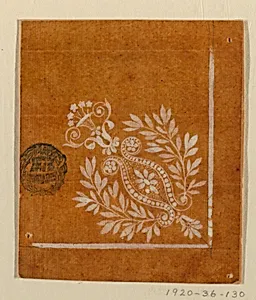
Design for an Embroidered or Woven Corner Motif of the "Fabrique de St. Ruf"
1800–1825
Medium
Drawing
Classification
Drawing
Department
Smithsonian Collection
Museum
Smithsonian American Art Museum
Credit
Gift of Eleanor and Sarah Hewitt
Accession Number
1920-36-130
Rights
Public Domain
About this artwork
Research in Progress
Art Historical Context
This delicate drawing, titledDesign for an Embro or Woven Corner Mot of the "Fabrique St. Ruf"*, hails from the renowned textile hub of Lyon, France, created between 1800 and 1825 by the Fabrique Saint Ruf workshop. Lyon was Europe's silk-weaving capital during this era, producing luxurious fabrics for fashion and furnishings amid the Napoleonic Empire's opulent tastes. As a preparatory sketch, it served as a blueprint for artisans, guiding the intricate patterns in embroidery or jacquard looms—highlighting the fusion of fine art and industrial craft that defined French textile innovation. The work exemplifies early 19th-century design practices, where detailed drawings like this one translated artistic vision into repeatable motifs for shawls, upholstery, or garments. Corner motifs were especially prized for framing larger textiles, adding symmetry and elegance. Though research continues, its survival underscores the Hewitt sisters' passion for preserving such ephemera; gifted to the Smithsonian, it now enriches our understanding of how everyday luxury was meticulously planned. Visitors will appreciate this piece's quiet elegance—a window into Lyon's golden age of silk, where pencil strokes sparked shimmering masterpieces.