
Design for an Inlaid Circular Table Top, with Alternatives
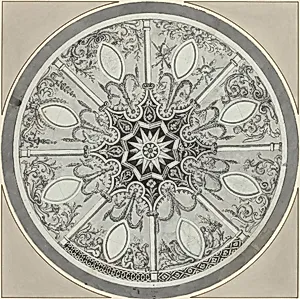
Medium
pen and gray ink with gray and black washes over graphite on laid paper
Dimensions
Overall (circular): 32.5 x 32.5 cm (12 13/16 x 12 13/16 in.) mount: 42.8 x 40.6 cm (16 7/8 x 16 in.)
Classification
Drawing
Department
CG-E
Museum
National Gallery of Art, Washington, D.C.
Credit
Ailsa Mellon Bruce Fund
Accession Number
1997.75.2
Rights
Public Domain
Art Historical Context
This exquisite drawing, titled *Design for an Inlaid Circular Table, with Alternatives*, dates to around 1800 and hails from a French or Italian workshop of the late 18th century. presents a meticulously planned circular tabletop, complete with variant motifs, showcasing the era's passion for luxurious furniture design. Such preparatory sketches were essential in the workshops of master cabinetmakers, bridging the gap between concept and craftsmanship during the Neoclassical period's transition to the Empire style, when symmetry, classical motifs, and intricate inlays symbolized refined taste among Europe's elite. Crafted in pen and gray ink with gray and black washes over graphite on laid paper, the work demonstrates virtuoso draftsmanship. The graphite underdrawing provides precise outlines, while layered washes add depth and tonal modeling, simulating the wood grains, marquetry, and polished surfaces of the envisioned table. Measuring 32.5 cm in diameter, this compact yet detailed sheet—now housed in the National Gallery of Art's collection through the Ailsa Mellon Bruce Fund—highlights the technical precision of period designers, who often explored multiple options on a single page to refine their commissions. For visitors, this piece offers a window into the collaborative artistry of decorative arts, where drawings like this guided artisans in creating opulent pieces for grand salons. Its survival underscores the enduring value of such functional elegance in 18th-century interiors.