
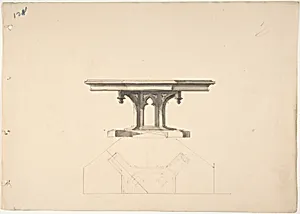
Design for an Octagonal Gothic Pedestal Table: Elevation and Plan
early 19th century
Medium
Pen and ink, brush and wash, over graphite
Dimensions
sheet: 8 3/4 x 12 5/16 in. (22.2 x 31.3 cm)
Classification
Drawings|Ornament & Architecture
Department
Drawings and Prints
Museum
Metropolitan Museum of Art, New York, NY
Credit
Harris Brisbane Dick Fund, 1938
Accession Number
38.37.116
Rights
Public Domain
Tags
Art Historical Context
This delicate drawing, titled *Design for an Octagonal Pedestal Table: Elevation Plan*, offers a glimpse into early 19th British design ingenuity. Created anonymously by a British artist around 1800–1820, it presents both a side elevation and top plan view of an elegant octagonal table supported by a pedestal base. Rendered on a modest sheet measuring 8 3/4 x 12 5/16 inches, the work resides in the Metropolitan Museum of Art's Drawings and Prints department, acquired through the Harris Brisbane Dick Fund in 1938. The piece reflects the Gothic Revival movement sweeping Britain at the time, a romantic resurgence of medieval motifs in furniture and architecture amid industrialization. Gothic elements—likely including pointed arches, tracery, or ornate piercings—infuse the pedestal table with historic grandeur, blending functionality with ornamental flair. Such designs were essential for cabinetmakers and architects, serving as precise blueprints to guide craftsmanship. Executed in pen and ink with brush and wash over graphite, the technique allowed for fine lines, subtle shading, and tonal depth, highlighting the designer's skill in conveying three-dimensional form on a flat surface. This anonymous gem underscores how everyday objects like tables became canvases for cultural revival, bridging art, ornament, and domestic life in Regency-era Britain.
About the Artist
Anonymous, British, 19th century · 1800–1900
**Anonymous, British, 19th century** is not the name of a single individual but a standard museum attribution used for works whose creators remain unidentified yet are clearly British and date to the 1800s. Major institutions, including the Metropolitan Museum of Art, employ this designation for hundreds of drawings, prints, designs, and decorative studies that lack signatures or firm documentary ...