
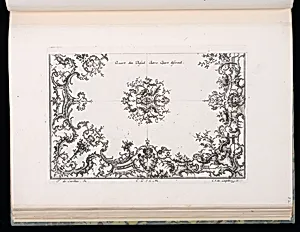
Design for Ceiling Ornament
Medium
Bound print
Classification
Bound print
Department
Smithsonian Collection
Museum
Smithsonian American Art Museum
Credit
Purchased for the Museum by the Advisory Council
Accession Number
1921-6-282-33
Rights
Public Domain
About this artwork
Research in Progress
Art Historical Context
François de Cuvilli the Elder (1695–1768), a Belgian-born architect and designer who thrived in Germany, was a master of the exuberant Rococo style during the mid-18th century. *Design for Ceiling Ornament*, created between 1740 and 1768, exemplifies his influence at the Bavarian court, he served as principal architect to Elector Maximilian III. Cuvilliés specialized in opulent interior decorations, blending playful asymmetry, scrolling motifs, and delicate flourishes that defined Rococo's lighthearted elegance—a reaction against the heavier Baroque of previous decades. Rendered as a bound print—a collection of engraved designs compiled into albums for study and replication—this work served as a practical blueprint for artisans crafting lavish palace ceilings, such as those in Munich's Amalienburg Pavilion. The medium of printmaking allowed Cuvilliés' intricate patterns to circulate widely across Europe, democratizing high-style ornamentation and influencing decorators far beyond royal commissions. Today, housed in the Smithsonian American Art Museum's collection (purchased by the Advisory Council), this piece highlights the fusion of artistry and architecture in Enlightenment-era Europe. Though research continues, it invites us to imagine gilded salons alive with Cuvilliés' whimsical vision, a testament to design's power to elevate everyday spaces into realms of fantasy.