
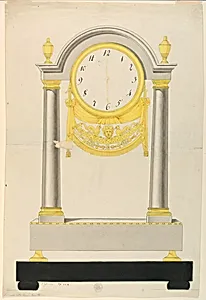
Design for Clock
1800–1825
Classification
timepieces & measuring devices
Department
Smithsonian Collection
Museum
Smithsonian American Art Museum
Credit
Gift of Eleanor and Sarah Hewitt
Accession Number
1931-71-20
Rights
Public Domain
About this artwork
Research in Progress
Art Historical Context
This elegant *Design for Clock* from Lefebvre Manufactory Tournai, Belgium, dates to the early 19th century (1800–1825), a period when Europe was embracing the grandeur of the Napoleonic Empire style. Created as a preparatory sketch or blueprint, it captures the meticulous planning behind luxury timepieces—objects that blended functionality with opulent decoration, symbolizing status in affluent households. Tournai was renowned for its porcelain and decorative arts workshops, and Lefebvre's output likely contributed to this tradition of finely crafted domestic wares. As a study in horological design, the piece highlights the era's fusion of mechanical precision and artistic flourish, where clocks often featured intricate cases adorned with motifs drawn from classical antiquity or nature. Though the exact medium remains under study, such designs were typically rendered in ink, watercolor, or gouache on paper, serving as vital links between artisan workshops and final products. Generously gifted to the Smithsonian American Art Museum by collectors Eleanor and Sarah Hewitt, this artifact joins the museum's distinguished collection of timepieces and measuring devices. It invites us to appreciate the unsung artistry of design drafts, offering a window into the collaborative craft that defined early industrial-era elegance. Research continues to uncover more about its creation, enriching our understanding of transatlantic decorative traditions.