
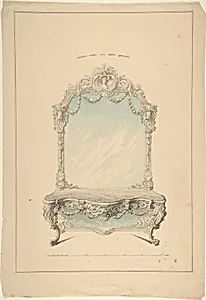
Design for Console Table
1850–1904
Medium
Pen and ink, graphite, watercolor
Classification
Drawings|Ornament & Architecture
Department
Drawings and Prints
Museum
Metropolitan Museum of Art, New York, NY
Credit
Bequest of Jessie F. Hume, 1930
Accession Number
30.16.8
Rights
Public Domain
Tags
Art Historical Context
Robert William Hume’s "Design for Console Table," created sometime between 1850 and 1904, offers a fascinating glimpse into the meticulous world of 19th-century furniture design. Rendered in pen and ink, graphite, and watercolor, this drawing belongs to the Metropolitan Museum of Art’s collection of ornament and architecture works. As a preparatory study, it highlights the decorative details—likely elegant legs, carved motifs, and balanced proportions—intended for a wall-mounted console table, a popular furnishing in Victorian-era homes. The medium’s combination of precise line work and subtle color washes allowed Hume to convey both structural form and ornamental flair, a standard technique for designers communicating ideas to craftsmen. Such drawings played a vital role in the period’s revival of historical styles, blending functionality with artistic expression to elevate everyday objects. Hume’s work reflects the era’s emphasis on ornament as a bridge between architecture and decorative arts. Acquired through the 1930 bequest of Jessie F. Hume, the piece preserves the creative process behind furniture that once graced elegant interiors, reminding visitors of how thoughtful design transformed utilitarian items into works of art.
About the Artist
Robert William Hume · 1816–1904
Robert William Hume (1816–1904) was a British artist and craftsman who contributed to the documentation of decorative arts and design in nineteenth-century Britain. Working during the Victorian era, Hume was part of a generation of artists and designers who combined artistic skill with antiquarian interests, producing detailed studies and records of historical objects, ornamental patterns, and arc...