
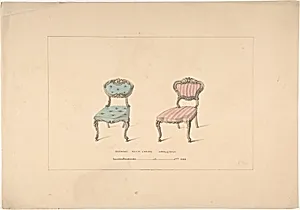
Design for Drawing Room Chairs, Louis Quinze Style
1835–1900
Medium
Pen and ink, watercolor
Classification
Drawings|Ornament & Architecture
Department
Drawings and Prints
Museum
Metropolitan Museum of Art, New York, NY
Credit
Bequest of Jessie F. Hume, 1930
Accession Number
30.16.22
Rights
Public Domain
Tags
Art Historical Context
Robert William Hume’s “Design for Drawing Room Chairs, Louis Quinze Style” captures the refined elegance of eighteenth-century French Rococo furniture through a nineteenth-century lens. Created between 1835 and 1900 in pen ink with watercolor, the drawing presents graceful chair designs marked by sinuous curves, cabriole legs, and delicate ornament—hallmarks of the Louis XV period. Such presentation drawings allowed designers to convey both structure and decorative detail to clients or craftsmen. In the Victorian era, when Hume was active, historic revival styles flourished as symbols of taste and cultural sophistication. By revisiting the playful asymmetry and naturalistic motifs of Louis Quinze design, Hume participated in a broader fascination with French courtly aesthetics. The watercolor medium adds subtle tonal warmth, suggesting fabric textures and gilded highlights while the precise ink lines ensure technical clarity for execution. Now part of the Metropolitan Museum’s collection of ornament and architecture through the bequest of Jessie F. Hume, this sheet offers visitors a glimpse into the creative process behind period interiors. It reminds us how drawings like this bridged past traditions with contemporary craftsmanship.
About the Artist
Robert William Hume · 1816–1904
Robert William Hume (1816–1904) was a British artist and craftsman who contributed to the documentation of decorative arts and design in nineteenth-century Britain. Working during the Victorian era, Hume was part of a generation of artists and designers who combined artistic skill with antiquarian interests, producing detailed studies and records of historical objects, ornamental patterns, and arc...