
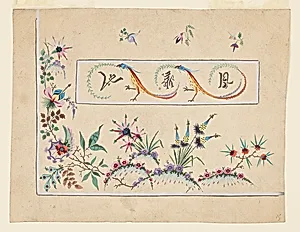
Design for Embroidery, Gentleman's Waistcoat Pocket
Classification
embroidery & stitching
Department
Smithsonian Collection
Museum
Smithsonian American Art Museum
Credit
Smithsonian American Art Museum
Accession Number
1962-59-2
Rights
Public Domain
About this artwork
Research in Progress
Art Historical Context
In the opulent world of late 18th-century French fashion, Jean-François Bony's *Design for Embroidery, Gentleman's Waistcoat Pocket* (ca. 1780) captures the exquisite detail that defined aristocratic menswear on the eve of the French Revolution. Bony, a skilled French designer (1754–1825), created this preparatory pattern for the pocket flap of a gentleman's waistcoat—a essential garment in the era's tailored ensembles, often showcasing wealth through lavish decoration. Held in the Smithsonian American Art Museum's embroidery and stitching collection, it reflects the height of textile artistry in pre-Revolutionary France, where such designs were commissioned for silk weavers in Lyon, Europe's embroidery capital. As a design rather than a finished piece, it highlights the collaborative craft of embroidery: artists like Bony sketched motifs—likely floral, pastoral, or neoclassical—for skilled needleworkers to execute in silk threads on luxurious fabrics. Waistcoats were status symbols, their pockets a canvas for intricate stitching that blended Rococo elegance with emerging Neoclassical restraint. Though research continues, this work underscores embroidery's role as fine art, bridging fashion, design, and cultural display in Enlightenment Europe. (178 words)