
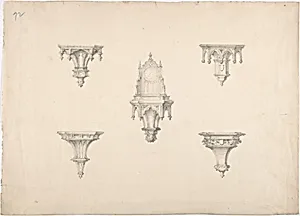
Design for Five Medieval Brackets, the Central One Bearing a Clock
early 19th century
Medium
Graphite
Dimensions
sheet: 10 11/16 x 14 15/16 in. (27.2 x 38 cm)
Classification
Drawings|Ornament & Architecture
Department
Drawings and Prints
Museum
Metropolitan Museum of Art, New York, NY
Credit
Harris Brisbane Dick Fund, 1938
Accession Number
38.37.203
Rights
Public Domain
Tags
Art Historical Context
This delicate graphite drawing, created by an anonymous British artist in the early 19 century, presents a refined design for five medieval-style brackets. The central bracket stands out, elegantly supporting a clock, while the flanking pairs feature intricate Gothic-inspired motifs like cusped arches and foliate details. Measuring 10 11/16 x 14 15/16 inches, this sheet exemplifies the precision of architectural ornament sketches from the period. In the Drawings and Prints department of The Metropolitan Museum of Art—acquired through the Harris Brisbane Dick Fund 1938—this work reflects Britain's early 19th-century fascination with medieval revivalism. During the Regency era, architects and designers drew on Gothic elements to evoke historical grandeur in public buildings, clocks, and furnishings. Graphite, a versatile medium favored for its subtlety and erasability, allowed the artist to explore proportions and decorative flourishes with fine-line hatching and subtle shading, bridging functional design and artistic expression. For visitors, this piece offers a window into the creative process behind ornate Victorian-era hardware, highlighting how everyday objects like brackets could embody cultural nostalgia and technical ingenuity.
About the Artist
Anonymous, British, 19th century · 1800–1900
**Anonymous, British, 19th century** is not the name of a single individual but a standard museum attribution used for works whose creators remain unidentified yet are clearly British and date to the 1800s. Major institutions, including the Metropolitan Museum of Art, employ this designation for hundreds of drawings, prints, designs, and decorative studies that lack signatures or firm documentary ...