
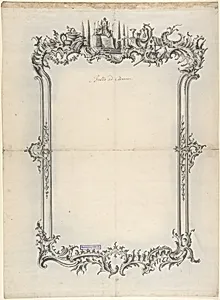
Design for Frame with Ecclesiastical Motifs
1750–88
Medium
Brush and black ink, and gray ink over traces of black chalk. Flaps of paper added to original and folded under at top and bottom. Incised for transfer.
Dimensions
18 7/16 x 13 7/16 in. (46.9 x 34.2 cm)
Classification
Drawings
Department
Drawings and Prints
Museum
Metropolitan Museum of Art, New York, NY
Credit
Purchase, The Elisha Whittelsey Fund, 1967
Accession Number
67.792.5
Rights
Public Domain
Tags
Art Historical Context
In the opulent world of 18th-century decorative arts, Johann Oktavian Salver *Design for Frame with Ecclesiastical Motifs* (ca. 1750–88) stands as a masterful preparatory drawing. Created during the late Baroque to Rococo transition, this work by the German engraver and designer exemplifies the era's fascination with intricate ornamentation for religious contexts. Salver, known for his detailed engravings and frames, crafted this sheet to guide the fabrication of an elaborate frame, likely intended to encase liturgical objects like altarpieces or reliquaries in churches. The medium—brush and black ink with gray ink over faint black chalk traces—reveals Salver's precise technique, allowing for fluid lines and subtle shading that evoke gilded wood carvings. Notable features include added paper flaps folded at top and bottom to expand the composition, and fine incisions along the edges for transfer, a practical method to replicate the design onto metal plates or wood templates. These elements highlight the collaborative process between artist and craftsman in producing sumptuous ecclesiastical furnishings. Housed in the Metropolitan Museum of Art's Drawings and Prints department (purchase, Elisha Whittelsey Fund, 1967), this 18 7/16 x 13 7/16 in. sheet offers a window into the Catholic Church's enduring tradition of lavish decoration, blending piety with artistic virtuosity during the Enlightenment age.