
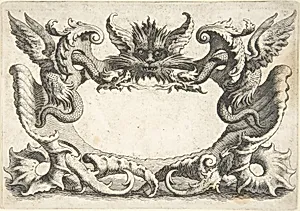
Design for ornamental cartouche
Medium
Engraving
Dimensions
sheet: 4 11/16 x 6 5/8 in. (11.9 x 16.9 cm)
Classification
Prints
Department
Drawings and Prints
Museum
Metropolitan Museum of Art, New York, NY
Credit
The Elisha Whittelsey Collection, the Elisha Whittelsey Fund
Accession Number
65.688.16
Rights
Public Domain
Tags
Art Historical Context
Quentin Pierre Chedel's *Design for Ornamental Cartouche* is a delicate engraving that exemplifies the ornate printmaking traditions of 18th-century France. As an engraver specializing in decorative motifs, Chedel crafted intricate designs like this undated work, which served as a model for architects, goldsmiths, and book designers. The medium of engraving—intaglio printing a copper plate—allowed for exceptional precision, capturing fine lines and textures that could be reproduced endlessly for practical use in furniture, cartouches on maps, or architectural embellishments. At its heart, the cartouche is an elaborate scrolled frame, often enclosing text, coats of arms, or illustrations, with fantastical dragons adding a dynamic, mythical flair. These creatures evoke the exuberant Baroque and emerging Rococo styles, blending symmetry with playful asymmetry to symbolize power and protection. Measuring just 4 11/16 x 6 5/8 inches, this compact sheet from The Metropolitan Museum of Art's Elisha Whittelsey Collection highlights how such prints democratized high design, bridging fine art and everyday ornamentation. Visitors will appreciate how Chedel's work reflects a golden age of European decorative arts, where fantasy met functionality in the hands of master engravers.