
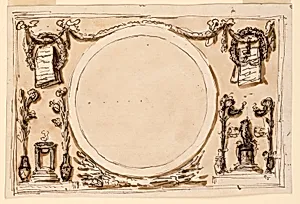
Design for Overmirror Decoration, Blank Roundel with Grotesques, for the Noble Cabinet of the Palazzo Altieri
1789–1793
Classification
architecture
Department
Smithsonian Collection
Museum
Smithsonian American Art Museum
Credit
Museum purchase through gift of various donors and from Eleanor G. Hewitt Fund
Accession Number
1938-88-1842
Rights
Public Domain
About this artwork
Research in Progress
Art Historical Context
Giuseppe Barberi, a Italian architect and designer active late 18th-century Rome1746–1809), created this intricate *Design for Overmirror Decoration, Blankel with Grotesques between 1789 and 1793. Intended for the Noble Cabinet of the Palazzo Altieri—a grand Baroque palace belonging to one of Rome's noble families—this architectural drawing outlines an elegant overmantel or overmirror ornament. At its center is a blank roundel, a circular panel framed by whimsical grotesques: fantastical motifs blending human, animal, and vegetal forms, inspired by ancient Roman discoveries. Dating to the Neoclassical era, Barberi's design reflects Rome's revival of classical antiquity amid the Enlightenment. Grotesques, popularized during the Renaissance by Raphael's Vatican decorations, symbolized inventive fantasy in architectural embellishment. Though the medium is unknown, such preparatory drawings were essential for guiding artisans in stucco, gilding, or fresco work, bridging architecture and interior decoration. This piece highlights Barberi's expertise in opulent palazzo interiors, where layered ornament elevated private spaces into showcases of aristocratic taste. Today, housed in the Smithsonian American Art Museum through a generous purchase, it offers a glimpse into 18th-century Roman luxury. Research continues to uncover more about its execution, inviting us to appreciate the artistry behind the grandeur.