
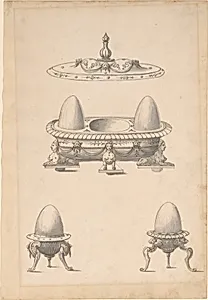
Design for Parade Egg Cups and Combined Egg Cup/Salt Cellar with Lid
16th century
Medium
Pen and ink, brush and wash
Dimensions
sheet: 15 1/2 x 10 1/2 in. (39.4 x 26.7 cm)
Classification
Drawings
Department
Drawings and Prints
Museum
Metropolitan Museum of Art, New York, NY
Credit
Anonymous Gift, in memory of Walter E. Stait, 2009
Accession Number
2009.526
Rights
Public Domain
Tags
Art Historical Context
In the opulent world of 16th-century Europe, Erasmus Hornick, a Flemish designer and engraver from Antwerp crafted intricate patterns for luxury metalwork. This drawing, titled *Design for Parade Egg Cups Combined Egg Cup/Saltar with Lid*, showcases his skill in envisioning elaborate tableware. Created with pen and ink for precise lines, enhanced by brush and wash for subtle shading and depth, the sheet (15½ x 10½ inches) likely served as a blueprint for goldsmiths transforming everyday items like egg cups into parade-worthy spectacles—perhaps for lavish banquets or civic processions of the Renaissance elite. Hornick's work reflects the Northern Renaissance's fusion of Gothic intricacy and emerging classical motifs, influencing decorative arts across Europe. Egg cups and salt cellars, symbols of hospitality and abundance, were elevated here into ornate vessels, blending functionality with display. The "parade" designation hints at ceremonial use, underscoring the era's fascination with virtuoso craftsmanship amid growing trade in silver and gold. Housed in the Metropolitan Museum of Art's Drawings and Prints department, this anonymous gift preserves a glimpse into the collaborative world of artists and artisans, where such designs bridged paper and precious metal, delighting collectors and revealing the splendor of 16th-century material culture.