
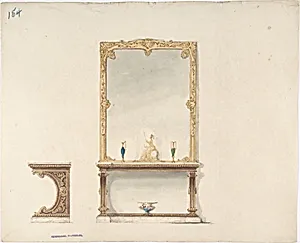
Design for Pier Table and Gold Mirror: Front and Side Elevations
early 19th century
Medium
Pen and ink, brush and wash, watercolor
Dimensions
sheet: 9 5/8 x 11 7/8 in. (24.5 x 30.2 cm)
Classification
Drawings|Ornament & Architecture
Department
Drawings and Prints
Museum
Metropolitan Museum of Art, New York, NY
Credit
Harris Brisbane Dick Fund, 1938
Accession Number
38.37.36
Rights
Public Domain
Tags
Art Historical Context
This delicate drawing, titled *Design for Pier Table and Gold Mirror Front and Side Elevations*, offers a glimpse into the refined world of early 19th-century British furniture design. Created anonymously by a British artist using pen and ink, brush and wash and watercolor on a modest sheet measuring 9 5/8 x 11 7/8 inches, it presents precise front and side views of pier table—a slender console table typically placed between windows in grand parlors—and its accompanying ornate gold mirror. Such designs were essential for architects, cabinetmakers, and homeowners seeking to furnish elegant interiors. In the Regency era's neoclassical revival, pier tables and mirrors symbolized sophistication and symmetry, reflecting the era's obsession with balanced proportions and gilded accents. This artifact, housed in the Metropolitan Museum of Art's Drawings and Prints department, exemplifies the meticulous planning behind ornamental architecture. The watercolor washes add depth and luminosity, mimicking the gleam of polished wood and gold leaf, while fine pen lines ensure technical accuracy for replication in workshops. As part of the Harris Brisbane Dick Fund collection since 1938, this work highlights the collaborative, often anonymous craft of design drafts that shaped British domestic luxury, inviting us to appreciate the artistry behind everyday opulence.
About the Artist
Anonymous, British, 19th century · 1800–1900
**Anonymous, British, 19th century** is not the name of a single individual but a standard museum attribution used for works whose creators remain unidentified yet are clearly British and date to the 1800s. Major institutions, including the Metropolitan Museum of Art, employ this designation for hundreds of drawings, prints, designs, and decorative studies that lack signatures or firm documentary ...