
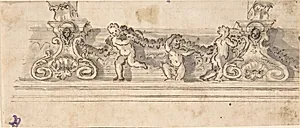
Design for the Decoration of a Cornice with Putti holding a Garland (recto); Red Chalk Sketches (verso)
17th century
Medium
Pen and brown ink over ruled lines and black chalk underdrawing, with brush and gray and blue wash (recto); red chalk (verso)
Dimensions
sheet: 3 5/8 x 8 7/16 in. (9.2 x 21.4 cm)
Classification
Drawings|Ornament & Architecture
Department
Drawings and Prints
Museum
Metropolitan Museum of Art, New York, NY
Credit
The Elisha Whittelsey Collection, The Elisha Whittelsey Fund, 1952
Accession Number
52.570.12
Rights
Public Domain
Tags
Art Historical Context
This delicate 17th-century Italian drawing, created anonymously, offers a glimpse into the preparatory world of Baroque-era architectural ornamentation. On the recto, it presents a refined design for decorating a cornice—a decorative molding crowning walls or ceilings—with playful putti (cherubic infants) supporting a flowing garland. These motifs, evoking classical antiquity, were staples in Italian interiors and facades, symbolizing abundance and delight during the opulent Baroque period. The employed sophisticated techniques: black chalk underdrawing and ruled lines guide the precise pen and brown ink outlines, enhanced by subtle gray and blue washes for depth and modeling. The verso features lively red chalk sketches, likely studies for figures or motifs, showcasing the economical double-sided use of paper common among draftsmen. At just 3 5/8 x 8 7/16 inches, this sheet from The Metropolitan Museum of Art's Elisha Whittelsey Collection highlights the meticulous planning behind grand decorative schemes. Such works underscore Italy's enduring influence on European design, where ornament fused architecture with sculpture. For visitors, it's a charming window into the creative process, revealing how whimsical putti and garlands brought joy to 17th-century palaces and churches.