
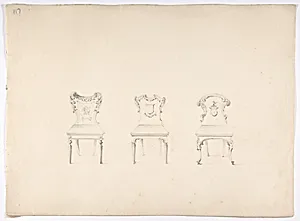
Design for Three Chairs with Armorial Ornament on Backs
early 19th century
Medium
Graphite
Dimensions
sheet: 10 7/8 x 14 13/16 in. (27.7 x 37.7 cm)
Classification
Drawings|Ornament & Architecture
Department
Drawings and Prints
Museum
Metropolitan Museum of Art, New York, NY
Credit
Harris Brisbane Dick Fund, 1938
Accession Number
38.37.82
Rights
Public Domain
Tags
Art Historical Context
This delicate graphite drawing, titled *Design for Three Chairs with Armorialnament on Backs*, a glimpse into early th-century British furniture design Created anonymously by a British artist around this period, it features precise sketches of three elegant chairs, each distinguished by ornate armorial decorations on the backs—heraldic motifs symbolizing family lineage, status, and prestige. Measuring 10 7/8 x 14 13/16 inches, the sheet captures the refined taste of Regency-era interiors, where such furnishings graced the homes of the elite. As a work in graphite on paper, classified under Drawings and Ornament & Architecture, it exemplifies the preparatory techniques of the time. Architects and designers relied on these detailed renderings to communicate ideas to craftsmen, blending functionality with symbolic embellishment. The armorial elements highlight Britain's enduring fascination with heraldry, a cultural tradition rooted in medieval chivalry that persisted into the 19th century amid growing industrialization. Acquired through the Harris Brisbane Dick Fund in 1938 and housed in the Metropolitan Museum of Art's Drawings and Prints department, this anonymous gem invites us to appreciate the unsung artistry behind everyday luxury. It reminds visitors how a simple sketch could shape grand domestic spaces.
About the Artist
Anonymous, British, 19th century · 1800–1900
**Anonymous, British, 19th century** is not the name of a single individual but a standard museum attribution used for works whose creators remain unidentified yet are clearly British and date to the 1800s. Major institutions, including the Metropolitan Museum of Art, employ this designation for hundreds of drawings, prints, designs, and decorative studies that lack signatures or firm documentary ...