
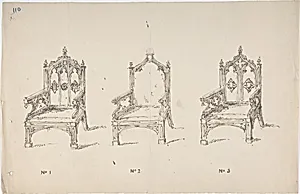
Design for Three Low Gothic Style Arm Chairs
early 19th century
Medium
Pen and ink
Dimensions
sheet: 8 1/16 x 12 9/16 in. (20.5 x 31.9 cm)
Classification
Drawings|Ornament & Architecture
Department
Drawings and Prints
Museum
Metropolitan Museum of Art, New York, NY
Credit
Harris Brisbane Dick Fund, 1938
Accession Number
38.37.57
Rights
Public Domain
Tags
Art Historical Context
This delicate pen and ink drawing from early 19th-century Britain presents designs for three low armchairs in the Gothic style, a nod to medieval aesthetics revived during the Regency era. Created anonymously by a British designer, the sheet showcases precise renderings of sturdy, low-slung seats adorned with pointed arches, tracery, and ornate detailing—hallmarks of Gothic ornamentation adapted for domestic comfort. At just over 8 by 12 inches, it's a compact working drawing, likely intended for furniture makers or architects blending historical revival with everyday utility. The Gothic Revival movement, gaining momentum around 1800, reflected Britain's fascination with its medieval past amid industrialization and Romanticism. Furniture designs like these promoted "Gothic" as a counterpoint to neoclassical restraint, emphasizing verticality, intricate carving, and moral symbolism tied to ecclesiastical architecture. Pen and ink was the ideal medium for such technical sketches, allowing sharp lines to convey proportions, joinery, and embellishments with economical precision. Housed in the Metropolitan Museum of Art's Drawings and Prints department (acquired via the Harris Brisbane Dick Fund in 1938), this artifact offers a glimpse into the era's design workshops, where ornament and architecture intertwined to shape modern interiors. A charming testament to creativity in constraint!
About the Artist
Anonymous, British, 19th century · 1800–1900
**Anonymous, British, 19th century** is not the name of a single individual but a standard museum attribution used for works whose creators remain unidentified yet are clearly British and date to the 1800s. Major institutions, including the Metropolitan Museum of Art, employ this designation for hundreds of drawings, prints, designs, and decorative studies that lack signatures or firm documentary ...