
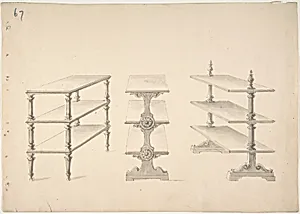
Design for Three Sets of Shelves
early 19th century
Medium
Pen and ink, brush and wash
Dimensions
sheet: 8 11/16 x 12 5/16 in. (22 x 31.2 cm)
Classification
Drawings|Ornament & Architecture
Department
Drawings and Prints
Museum
Metropolitan Museum of Art, New York, NY
Credit
Harris Brisbane Dick Fund, 1938
Accession Number
38.37.125
Rights
Public Domain
Tags
Art Historical Context
This delicate drawing from the early 19th century offers a window into British furniture design during the Regency period. Created by an anonymous artist, it presents three alternative sets of shelves, reflecting the era’s emphasis on elegant, functional pieces suited to refined domestic interiors. As Britain transitioned from neoclassical restraint toward the more decorative tastes of the Victorian age, such designs helped shape the look of middle- and upper-class homes. Executed in pen and ink with brush and wash, the sheet combines precise line work with subtle tonal shading to convey depth and material. This technique was standard for ornamental and architectural drawings, allowing makers and patrons to visualize how the shelves would appear in three dimensions before any wood was cut. The work belongs to the museum’s collection of ornament and architecture studies, underscoring how even utilitarian objects were treated with artistic care. Acquired by the Metropolitan Museum in 1938 through the Harris Brisbane Dick Fund, the drawing preserves a moment when craftsmanship and design converged in everyday life. Its focus on furniture highlights the cultural value placed on well-proportioned storage solutions that balanced beauty with practicality.
About the Artist
Anonymous, British, 19th century · 1800–1900
**Anonymous, British, 19th century** is not the name of a single individual but a standard museum attribution used for works whose creators remain unidentified yet are clearly British and date to the 1800s. Major institutions, including the Metropolitan Museum of Art, employ this designation for hundreds of drawings, prints, designs, and decorative studies that lack signatures or firm documentary ...