
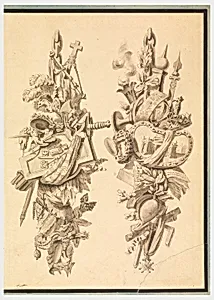
Design for Two Trophies
Classification
ornament
Department
Smithsonian Collection
Museum
Smithsonian American Art Museum
Credit
Gift of H. O. Havemeyer
Accession Number
1907-13-6-1
Rights
Public Domain
About this artwork
Research in Progress
Art Historical Context
Jean-Charles Delafosse a prominent French artist of the Rococo era (1734–1789), created *Design for Two Trophies around 1750, capturing the exuberant spirit of mid-18th-century decorative arts. in Paris, Delafosse was renowned for his intricate ornamental designs, pattern books, and contributions to architecture and furniture, often blending classical motifs with playful, asymmetrical flourishes characteristic of Rococo style. This work exemplifies his expertise in crafting trophies—elaborate symbolic assemblages of attributes like laurels, shields, and allegorical figures, evoking triumph or virtue for grand interiors, furniture, or public monuments. As a preparatory design classified as ornament, it likely served as a blueprint for artisans, highlighting Rococo's emphasis on elegance, movement, and naturalistic details rendered with precise lines. Trophies were a staple of the period's opulent aesthetic, adorning Versailles and aristocratic salons, reflecting France's cultural dominance in luxury crafts during Louis XV's reign. Now in the Smithsonian American Art Museum's collection, gifted by collector H.O. Havemeyer, this piece invites us to appreciate the artistry behind everyday splendor. Though research continues, it stands as a window into Rococo's whimsical legacy, bridging fine art and design.