
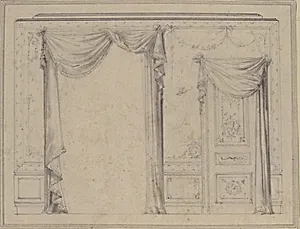
Design for Wall Treatment with Window and Door
19th century
Medium
Graphite
Dimensions
7 7/8 x 10in. (20 x 25.4cm)
Classification
Drawings
Department
Drawings and Prints
Museum
Metropolitan Museum of Art, New York, NY
Credit
The Elisha Whittelsey Collection, The Elisha Whittelsey Fund, 1969
Accession Number
69.660.3
Rights
Public Domain
Tags
Art Historical Context
In the Metropolitan Museum of Art's Drawings and Prints department, Charles Monblond's *Design for Wall Treatment with and Door* (19th century) offers a glimpse into the meticulous world of architectural planning. Rendered in graphite on a modest 7 7/8 x 10-inch sheet, this drawing from The Elisha Whittelsey Collection captures the artist's precise hand in outlining an interior scheme. Monblond, a designer of the era, likely created it as a preparatory study, showcasing his skill in balancing functionality with aesthetic harmony. The composition centers on a wall treatment featuring a gracefully arched window and door, enhanced by flowing curtains that add softness to the architectural lines. Graphite's versatility shines here, enabling delicate shading and intricate detailing—techniques essential for conveying texture and depth in proposal sketches. Such works were vital in the 19th century, when rapid urbanization fueled demand for refined domestic spaces, blending practicality with emerging styles like neoclassicism or historicism. This intimate drawing invites visitors to appreciate the unsung artistry behind built environments, highlighting how simple pencil strokes could shape elegant homes. Acquired through The Elisha Whittelsey Fund in 1969, it preserves a slice of design history for modern eyes.
About the Artist
Charles Monblond · 1800–1900
**Charles Monblond**, a French painter and designer born in Paris, flourished during the mid- to late nineteenth century, capturing the ornate spirit of Second Empire decorative arts through his meticulous drawings and paintings. Residing at 9 Rue Marignan, he studied under M. Ch. Polisch, honing skills that blended floral still lifes with architectural ornamentation. In 1866, Monblond sought perm...