
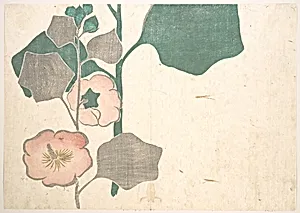
Design of Flowers
Medium
Woodblock print (leaf from an album); ink and color on paper
Dimensions
H. 10 in. (25.4 cm); W. 14 3/16 in. (36 cm)
Classification
Prints
Culture & Period
Japan · Edo period (1615–1868)
Department
Asian Art
Museum
Metropolitan Museum of Art, New York, NY
Credit
H. O. Havemeyer Collection, Bequest of Mrs. H. O. Havemeyer, 1929
Accession Number
JP1828
Rights
Public Domain
Tags
Art Historical Context
Ogata Kōrin's *Design of Flowers*, a woodblock print from an album leaf, captures the vibrant essence of nature during Japan's Edo period (16151868). Created with ink and color on paper this 10-by-14-inch sheet showcases Kōrin's mastery in the Rinpa school, a decorative style emphasizing bold floral motifs, asymmetry, and rhythmic patterns inspired by seasons and poetry. Though the exact date is unknown, it the era's flourishing urban culture, where art celebrated beauty amid peace and prosperity. Kōrin, a leading Rinpa artist, elevated traditional flower depictions through innovative techniques like layered colors and flowing lines that mimic petals and leaves in motion. Woodblock printing, a hallmark of Japanese printmaking, allowed such intricate designs to be reproduced, bridging elite painting traditions with broader appreciation. The tags of flowers and leaves highlight its focus on ephemeral natural beauty, a core Rinpa theme symbolizing life's transience (mono no aware). Housed in the Metropolitan Museum of Art's Asian Art Department as part of the prestigious H. O. Havemeyer Collection (bequeathed in 1929), this print invites visitors to savor Edo Japan's artistic elegance, where everyday motifs became timeless poetry on paper.
About the Artist
Ogata Kōrin · 1658–1716
Noted as one of the most important Japanese artists of the 17th century; known for paintings of irises and other subjects. He was regarded, along with Sotatsu, as one of the masters of the Sotatsu-Koetsu school of decorative painting, including painted screens and textile designs. He was descended from a samurai who had served under the Ashikaga rulers.