
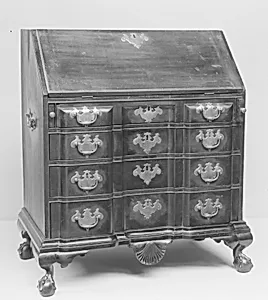
Desk
Unknown Artist
1760–90
Medium
Mahogany, white pine
Dimensions
36 1/8 x 32 3/8 x 18 1/2 in. (91.8 x 82.2 x 47 cm)
Classification
Desk
Culture
American
Department
The American Wing
Museum
Metropolitan Museum of Art, New York, NY
Credit
John Stewart Kennedy Fund, 1918
Accession Number
18.110.56
Rights
Public Domain
Art Historical Context
This elegant mahogany desk, crafted by an unknown American artisan between 1760 and1790, exemplifies the refined craftsmanship of the late Colonial period. Measuring a compact 36 1/8 x 32 3/8 x 18 1/2 inches, it was likely designed for a gentleman's study or parlor, where writing correspondence or managing household accounts was a mark of status. The primary wood, richly figured mahogany imported from the Caribbean or Honduras, was a luxury material symbolizing wealth and transatlantic trade connections, while the white pine secondary wood provided sturdy, lightweight support hidden from view. In the context of pre-Revolutionary America, such desks reflected the growing sophistication of colonial furniture making, blending British rococo influences with practical American ingenuity. Artisans veneered and inlaid the mahogany for durability and visual appeal, showcasing joinery techniques like dovetailing that ensured longevity. Acquired through the John Stewart Kennedy Fund in 1918, this piece now graces the Metropolitan Museum of Art's American Wing, offering a tangible link to everyday life in an era of emerging national identity. Today, it invites us to imagine the quill pens and inkwells that once rested upon its slant-top surface, highlighting how furniture served as both functional art and a canvas for cultural aspiration in early America.