
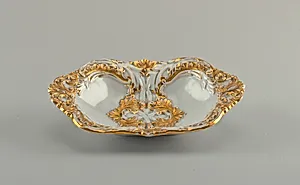
Dessert Dish
Classification
ceramics
Department
Smithsonian Collection
Museum
Smithsonian American Art Museum
Credit
Bequest of Emily H. Chauncey
Accession Number
1959-155-11
Rights
Public Domain
About this artwork
Research in Progress
Art Historical Context
This elegant **Dessert Dish** from Meissen Porcelain Manactory exemplifies the enduring legacy of Europe's pioneering porcelain producer, founded in 1710 near Dresden, Germany. Meissen achieved a world first by developing hard-paste porcelain—a durable, translucent material mimicking Chinese imports—under the patronage of Augustus the Strong. By the mid-19th century when this piece was made, the manufactory had mastered intricate techniques like underglaze painting, gilding, and sculptural modeling, blending neoclassical restraint with romantic flourishes to create luxurious tableware for Europe's elite. As a ceramic dessert dish, it reflects the era's obsession with refined dining rituals, where porcelain services symbolized wealth and sophistication. Meissen's output often featured delicate floral motifs, figural scenes, or pierced edges, showcasing technical virtuosity in firing kilns at high temperatures to achieve jewel-like sheen. Though specifics of its decoration await further research, such pieces were prized for their functionality and artistry, bridging utility and opulence. Now in the Smithsonian American Art Museum through the bequest of Emily H. Chauncey, this dish invites us to appreciate Meissen's 300-year influence on ceramics, from royal courts to modern collections. A testament to German craftsmanship, it whispers of grand 19th-century banquets. (198 words)