
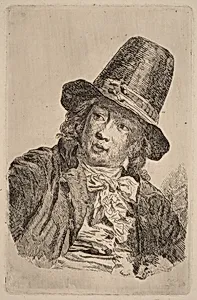
Detmar Friedrich Wilhelm Basse
c. 1782
Medium
etching on laid paper
Dimensions
plate: 18.3 x 10.9 cm (7 3/16 x 4 5/16 in.) sheet: 23.3 x 16.7 cm (9 3/16 x 6 9/16 in.)
Classification
Department
CG-E
Museum
National Gallery of Art, Washington, D.C.
Credit
Gift of Robert Paul Mann and Dorothy Neeld Mann
Accession Number
1999.128.2
Rights
Public Domain
Art Historical Context
**Portrait of Detmar Friedrich Wilhelm Basse** by Anton Graff (c. 1782) captures the refined likeness of its sitter in a delicate etching on laid paper, a prized in the 18th century for subtle texture and ability to hold fine ink lines. Measuring a modest plate size of 18.3 x 10.9 cm, this intimate print exemplifies Graff's mastery as a leading Swiss-German portraitist of the Enlightenment era. Working primarily in Dresden, Graff blended Rococo elegance with emerging Neoclassical clarity, producing realistic depictions of intellectuals, nobles, and officials that conveyed character through precise facial details and poised expressions. Etching, an intaglio technique where acid bites into a metal plate to create intricate lines, allowed Graff to replicate the luminosity and psychological depth of his oil paintings in reproducible form. Laid paper, with its visible chain lines from the manufacturing mold, enhanced the print's tactile authenticity, making it a coveted collector's item. This work likely served to disseminate Basse's image among Europe's cultured elite, reflecting the period's fascination with portraiture as a tool for social identity and legacy. Housed in the National Gallery of Art's Prints department as a gift from Robert Paul Mann and Dorothy Neeld Mann, this etching offers a window into late-18th-century portrait traditions, where art bridged personal portraiture and public dissemination. Visitors will appreciate its technical finesse and historical poise—a testament to Graff's enduring influence.