
Devotional pendant
Unknown Artist
late 16th century
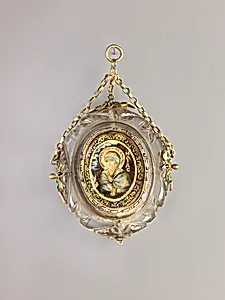
Medium
Cut and polished, reverse-painted, reverse-gilt, and reverse-silvered rock crystal; gold wire; gold; enamel; Assembled.
Dimensions
H. 5.7 cm, W. 4.2 cm, D. .5 cm
Classification
Jewelry, Precious Metals and Precious Stones
Culture
Italian, Lombardy or possibly the Veneto
Department
Robert Lehman Collection
Museum
Metropolitan Museum of Art, New York, NY
Credit
Robert Lehman Collection, 1975
Accession Number
1975.1.1519
Rights
Public Domain
Tags
Art Historical Context
This exquisite devotional pendant, crafted in 16th-century Italy—likely from Lombardy or Veneto region—exemplifies the era's masterful jewelry artistry. Housed in the Metropolitan Museum of Art's Robert Lehman Collection, this treasure (5.7 cm high) was designed for personal wear, blending spirituality with opulent display. Its classification as jewelry in precious metals and stones underscores role as both a pious accessory and a status symbol for elite patrons during the late Renaissance. The pendant's ingenuity shines in its complex medium: cut and polished rock crystal, meticulously reverse-painted, reverse-gilt, and reverse-silvered to create vivid, three-dimensional illusions when viewed from the front. Delicate gold wire, gold elements, and enamel are assembled with precision, producing shimmering effects that catch the light like a miniature reliquary. This technique, popular in northern Italian workshops, highlighted the artisan's virtuosity in manipulating transparent crystal to evoke depth and luminescence. As a devotional object tagged for men, it likely served private prayer, reflecting Counter-Reformation piety amid Italy's artistic fervor. Such pendants bridged faith and fashion, inviting wearers to carry sacred imagery close to the heart in an age of religious intensity and technical innovation.