
Diablerie: A Satire on the Medical Profession
1612–41
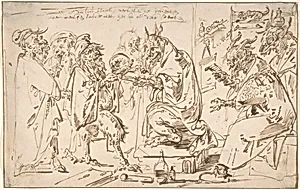
Medium
Pen and brown ink
Dimensions
7 x 11 1/16 in. (17.8 x 28.1 cm)
Classification
Drawings
Department
Drawings and Prints
Museum
Metropolitan Museum of Art, New York, NY
Credit
Harry G. Sperling Fund, 2001
Accession Number
2001.114
Rights
Public Domain
Tags
Art Historical Context
In the spirited drawing *Diablerie: A Satire on the Medical Profession created by Dutch artist Andries Both (ca. 1611/12–1642) sometime between 1612 and1641, viewers encounter a biting caricature that skewers the medical practices of the early 17th century.ed in pen and brown ink on a modest sheet measuring 7 x 11 /16 inches, the work employs exaggerated forms, skulls, and diabolical motifs to lampoon physicians, portraying them as quacks or even devilish charlatans amid the era's rampant medical superstitions and ineffective treatments. Both, known for his lively genre scenes in the Dutch Baroque tradition, masterfully uses the fluid lines of pen and ink to heighten the satirical bite—quick, gestural strokes capture grotesque expressions and chaotic compositions typical of caricature. This medium allowed for intimate, portable sketches that circulated widely, amplifying social commentary during the Dutch Golden Age when public distrust of healers ran high amid plagues and pseudoscience. Today, housed in the Metropolitan Museum of Art's Drawings and Prints department (acquired via the Harry G. Sperling Fund in 2001), this piece highlights the cultural role of satire in critiquing authority. It invites us to chuckle at history's follies while appreciating how art has long served as a mirror to society's medical mishaps.
About the Artist
Andries Both · 1612–1641
**Andries Both** (c. 1612/1613–1642) was a Dutch genre painter best known for his lively depictions of everyday life among the lower classes in Rome and its countryside. Born in Utrecht as the son of glass painter Dirck Both, he trained alongside his brother Jan under the prominent Utrecht master Abraham Bloemaert, with records confirming his apprenticeship in 1624–1625. Both and his brother trav...