
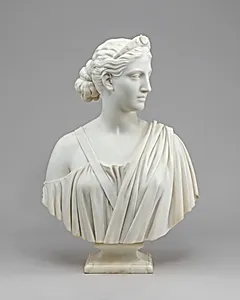
Diana
model 1852, carved 1853
Medium
marble
Dimensions
overall: 76.84 × 53.34 × 33.02 cm (30 1/4 × 21 × 13 in.)
Classification
Sculpture
Department
CSD
Museum
National Gallery of Art, Washington, D.C.
Credit
Corcoran Collection (Gift of Stella McCalla Sands)
Accession Number
2015.19.3748
Rights
Public Domain
Art Historical Context
Hiram Powers' *Diana*, modeled in 1852 and the following year, exemplifies the neoclassical sculpture of mid-19th-century America Crafted from pristine white marble, this 30-inch-tall figure captures the Roman goddess of the hunt in a poised, idealized form. Powers, a leading expatriate sculptor based in Florence, Italy, drew on classical antiquity to create works that blended technical precision with sensual elegance, making his sculptures highly sought after by collectors. The artwork's modest dimensions—76.84 × 53.34 × 33.02 cm—suggest it as a tabletop or mantelpiece piece, intimate yet commanding. Marble, revered since ancient Greece and Rome, allowed Powers to showcase his mastery of carving, achieving lifelike textures from flowing drapery to smooth skin. Diana, symbolizing chastity and wilderness prowess, reflects the era's fascination with mythological heroines amid growing interest in women's independence. Now part of the National Gallery of Art's Corcoran Collection, gifted by Stella McCalla Sands, *Diana* highlights Powers' role in popularizing neoclassicism stateside. Visitors admire how it bridges Renaissance revival and Victorian tastes, inviting reflection on beauty, mythology, and artistry.
About the Artist
Hiram Powers · 1805–1873
Comment on works: sculptor