
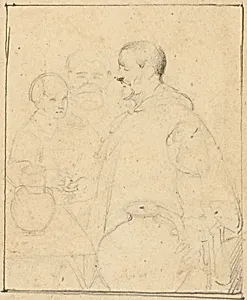
Dido Waving Her Love to Carthage
n.d.
Medium
Drawing
Classification
Drawing
Department
Smithsonian Collection
Museum
Smithsonian American Art Museum
Credit
Smithsonian American Art Museum, Gift of Pauline Page Howell
Accession Number
1973.183.27
Rights
Public Domain
Tags
Art Historical Context
Behold *Dido Waving Her to Carthage*, an evocative drawing by 19th-century American artist Page (1811–5). This undated work captures the legendary Queen Dido of Carthage, a poignant figure from Virgil's *Aeneid*, in a moment of farewell. As the sole female figure dominating the composition, she embodies themes of love, loss, and destiny, waving to her departing lover Aeneas as he sets sail—evoking the tragic romance that has inspired artists for centuries. Page, renowned for his portraits and ideal figure studies influenced by Venetian Renaissance masters like Titian, favored a realistic yet luminous style. As a drawing, this piece likely served as a preparatory sketch or independent study, highlighting his mastery of line, form, and emotional expression on paper. Such works reveal the artist's process, bridging classical mythology with American Romanticism during a time when U.S. artists drew heavily from European traditions. Now housed in the Smithsonian American Art Museum through the generous gift of Pauline Page Howell, this drawing invites visitors to ponder Dido's enduring story: a queen torn between passion and duty. It's a window into Page's world, where antiquity meets 19th-century sensibility.
About the Artist
William Page · 1811–1885
Comment on works: History; Portraits; Genre; Landscapes