
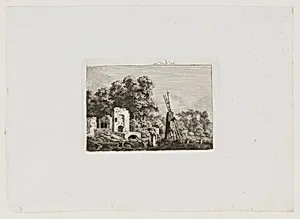
Die Brandstatte (The Fire)
Medium
Etching; second state
Dimensions
Sheet: 8 in. × 11 1/4 in. (20.3 × 28.5 cm) Plate: 3 5/8 × 5 3/8 in. (9.2 × 13.7 cm) Image: 3 5/16 × 4 7/8 in. (8.4 × 12.4 cm)
Classification
Prints
Department
Drawings and Prints
Museum
Metropolitan Museum of Art, New York, NY
Credit
Harris Brisbane Dick Fund, 1927
Accession Number
27.36.1
Rights
Public Domain
Art Historical Context
Caspar David Friedrich, a figure in German Romanticism, crafted *Die Brandstatte ( Fire)* in 1802 as an early etching, showcasing his emerging mastery of printmaking before his fame in oil landscapes. At just 28, Friedrich captured the sublime and melancholic essence of nature's forces, themes central to Romanticism's emphasis on emotion, ruin, and the transient beauty of the world. This intimate work, titled after a fire-ravaged site, invites viewers to ponder destruction and renewal amid vast, moody atmospheres. Rendered in the second state of the etching—a revision where the artist refined lines by burnishing or adding details—the piece exemplifies the precision of this intaglio technique. Acid bites into a copper plate to create delicate, expressive lines, allowing for subtle tonal variations on a modest scale: the image measures only 3 5/16 × 4 7/8 inches. Such prints were prized in the early 19th century for their affordability and reproducibility, democratizing art while highlighting Friedrich's atmospheric sensitivity. Acquired through the Harris Brisbane Dick Fund in 1927, this etching resides in the Metropolitan Museum of Art's Drawings and Prints department. It offers a rare glimpse into Friedrich's experimental youth, bridging his graphic roots with the monumental visions that would define Romantic art.
About the Artist
Caspar David Friedrich · 1774–1840
Leading artist of the German Romantic movement. He was particularly known for his symbolic and atmospheric treatment of landscape.