
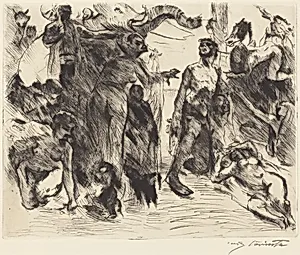
Die Versuchung des heiligen Antonius (The Temptation of Saint Anthony)
1919
Medium
drypoint in black
Dimensions
plate: 24.1 x 30.3 cm (9 1/2 x 11 15/16 in.) sheet: 33.1 x 42.1 cm (13 1/16 x 16 9/16 in.)
Classification
Department
CG-W
Museum
National Gallery of Art, Washington, D.C.
Credit
Rosenwald Collection
Accession Number
1947.7.28
Rights
Public Domain
Art Historical Context
Lovis Corinth's *Die Versuchung des heil Antonius (The Temptation of Saint Anthony)*, created in 1919, a timeless religious narrative through the lens of early 20th-century German Expressionism. The German artist, renowned for his bold evolution from Impressionism to raw, emotive forms after a debilitating stroke in 1911, depicts the desert hermit Saint Anthony besieged by demonic temptations—a motif popularized in art from Bosch to Flaubert's novel. Executed late in Corinth's career amid the turmoil of post-World War I Germany, the print reflects his intensified focus on psychological drama and spiritual strife. This drypoint etching in black exemplifies Corinth's mastery of intaglio printmaking. The technique, using a hard needle to scrape directly into the copper plate, creates a characteristic burr that holds ink for richly textured, velvety lines—ideal for conveying the grotesque visions tormenting the saint. Measuring 24.1 x 30.3 cm on the plate (33.1 x 42.1 cm sheet), its intimate scale invites close viewing, revealing Corinth's loose, vigorous strokes that evoke movement and torment. Housed in the National Gallery of Art's Rosenwald Collection, this work highlights Corinth's print legacy, bridging traditional religious iconography with modernist intensity. Visitors will appreciate how it distills human frailty into haunting, ink-drenched forms, a testament to resilience in art and life.
About the Artist
Lovis Corinth · 1858–1925
Lovis Corinth, born Franz Heinrich Louis on July 21, 1858, in Tapiau, East Prussia (now Gvardeysk, Russia), to a tanner father, displayed prodigious drawing talent from childhood. He began formal training at the Königsberg Academy in 1876, then moved to the Academy of Fine Arts in Munich from 1880 to 1884, studying under Ludwig von Löfftz and briefly Franz von Defregger, where he absorbed a Realis...