
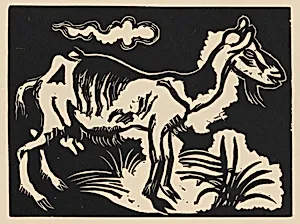
Die Ziege (The Goat) from Deutsche Graphiker der Gegenwart (German Printmakers of Our Time)
1920
Medium
woodcut from a bound volume with 15 lithographs, eight woodcuts, eight photomechanical reproductions, and one drypoint
Classification
Department
CG-W
Museum
National Gallery of Art, Washington, D.C.
Credit
Gift of Robert M. Walker
Accession Number
1980.26.2.11
Rights
Public Domain
Art Historical Context
**Die Ziege (The Goat)** by Richard Seewald, created in 1920, is a striking woodcut featured in the bound volume *Deutsche Graph der Gegenwart* ( Printmakers of Our Time This publication showcased the vibrant graphic arts scene in post-World War I Germany, bringing together works by leading contemporary artists through a mix of techniques: 15 lithographs, eight woodcuts like Seewald's, eight photomechanical reproductions, and one drypoint. Produced during the early Weimar Republic, it captured a moment of artistic renewal amid social upheaval, highlighting printmaking's accessibility as a democratic medium. Seewald's woodcut exemplifies the bold, reductive power of the technique, where carved wood blocks yield stark contrasts and textured lines ideal for evoking form and movement. The goat, a humble subject, likely draws on everyday rural motifs, rendered with the graphic intensity typical of early 20th-century European prints. As part of this collaborative volume, it underscores the era's fascination with print portfolios as affordable showcases of modern talent. Now housed in the National Gallery of Art's Department of Modern Prints (CG-W) through the generous gift of Robert M. Walker, *Die Ziege* invites visitors to appreciate how woodcuts bridged fine art and popular culture, preserving Seewald's contribution to Germany's interwar graphic legacy. (198 words)