
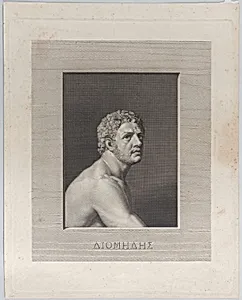
Diomedes, bust and shoulders
1790–1800
Medium
Engraving
Dimensions
Plate: 17 3/16 × 13 7/8 in. (43.6 × 35.2 cm) Sheet: 18 7/16 × 14 5/8 in. (46.8 × 37.1 cm)
Classification
Prints
Department
Drawings and Prints
Museum
Metropolitan Museum of Art, New York, NY
Credit
Gift of Harry Shaw Newman, 1941
Accession Number
41.97.574
Rights
Public Domain
Tags
Art Historical Context
Behold the commanding bust of *Diomedes, bust and shoulders*, an engraving by Johann Heinrich Wilhelm Tischbein, created between 1790 and 1800. Tischbein, a member of the prolific German Tischbein family of artists, was renowned for neoclassical portraits and historical scenes that evoked the grandeur of ancient Greece and Rome. Here, he captures Diomedes, the mighty warrior-hero from Homer's *Iliad*, famed for his bravery in wounding gods like Aphrodite and Ares during the Trojan War. intimate bust-and-shoulders format focuses on the hero's noble profile, idealizing his strength and valor in true neoclassical fashion. Engraving, the medium of this work, was a pinnacle of 18th-century printmaking technique. Tischbein incised fine lines into a metal plate—measuring 17 3/16 × 13 7/8 inches—to create intricate details of texture and shading, allowing for precise reproduction and widespread dissemination of classical imagery. This print reflects the era's obsession with antiquity, fueling the Enlightenment's revival of heroic ideals amid revolutionary upheavals in Europe. Today, this piece graces the Metropolitan Museum of Art's Drawings and Prints department, a gift from Harry Shaw Newman in 1941. It invites visitors to ponder how 19th-century artists like Tischbein bridged myth and modernity, making epic legends accessible through masterful craftsmanship.