
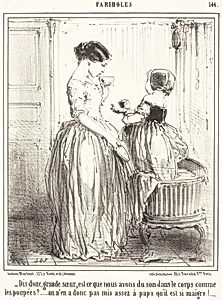
Dis-Donc, grande soeur...
1801 to 1825
Medium
lithograph
Dimensions
overall: 35.4 x 27.4 cm (13 15/16 x 10 13/16 in.)
Classification
Department
CG-E
Museum
National Gallery of Art, Washington, D.C.
Credit
Gift of Frank Anderson Trapp
Accession Number
2002.57.2
Rights
Public Domain
Art Historical Context
**Dis-Donc, grande soeur...** by Édouard de Beaumont is a charming lithograph from the early 19th century (ca. 1801–1825), measuring 35.4 x 27.4 cm. Housed in the National Gallery of Art's Prints department as a gift from Frank Anderson Trapp, this work exemplifies the burgeoning art of lithography, a revolutionary printing technique invented just a few years earlier in 1796 by Alois Senefelder. By drawing directly on a smooth stone with greasy crayon, artists like Beaumont could produce multiple high-quality impressions with rich tonal variations, bridging the gap between original sketches and mass reproduction. Beaumont, a French lithographer active during the Napoleonic era and Restoration period, specialized in lively genre scenes and fashion illustrations that captured the spirit of everyday Parisian life. The title—"Well then, big sister..."—hints at an intimate, conversational moment between siblings, evoking the warmth and whimsy of domestic interactions. This piece reflects lithography's rise as a democratic medium, making sophisticated art accessible beyond elite circles and fueling the popularity of satirical and social commentary prints. Its historical significance lies in showcasing an innovative technique that transformed visual culture, paving the way for modern graphic arts. Visitors will appreciate how Beaumont's delicate lines and subtle shading bring a slice of 19th-century sisterly banter to life, offering a window into the era's social graces and artistic ingenuity. (198 words)