
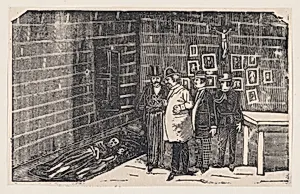
Discovery of two bodies
ca. 1880–1910
Medium
Type-metal engraving
Dimensions
Sheet: 3 1/8 × 5 1/8 in. (8 × 13 cm)
Classification
Prints
Department
Drawings and Prints
Museum
Metropolitan Museum of Art, New York, NY
Credit
Gift of Jean Charlot, 1930
Accession Number
30.82.81
Rights
Public Domain
Tags
Art Historical Context
José Guadalupe Posada, a Mexican printmaker active in Mexico City from the late 19th to early 20th century, *Discovery of Two Bodies* around 1880–1910. This type-metal engraving depicts a grim scene of skeletons—likely representing two men—evoking the macabre discovery suggested by its title. Posada's works often featured such skeletal figures, or *calaveras*, drawn from Mexican folk traditions and the Día de los Muertos celebrations, blending death with wry social commentary. Rendered in a modest sheet size of 3 1/8 × 5 1/8 inches, the print employs type-metal engraving, a relief technique using leftover metal from printing presses. This economical method allowed Posada to produce thousands of affordable broadsides for newspapers, pamphlets, and ballads (*corridos*), making art accessible to the working class. His bold black lines and stark contrasts captured everyday life, politics, and mortality with satirical bite, influencing generations of Mexican artists like Diego Rivera. Today, this piece from the Metropolitan Museum of Art's Drawings and Prints collection highlights Posada's role in shaping modern Mexican graphic art. It invites visitors to reflect on universal themes of death and discovery through his unflinching, yet darkly humorous lens.
About the Artist
José Guadalupe Posada · 1852–1913
José Guadalupe Posada (1852-1913) was a Mexican printmaker and engraver who revolutionized popular art and created some of the most iconic images in Mexican culture. Working primarily with publisher Antonio Vanegas Arroyo, he produced over 20,000 images during his career—inexpensive broadsheets sold for a penny on colored paper that made his art accessible to even the poorest workers. He transform...