
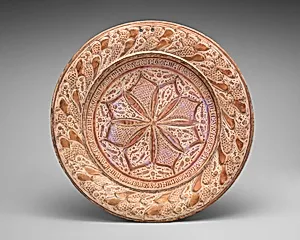
Dish
Unknown Artist
16th century
Medium
Tin-glazed and luster-painted earthenware
Dimensions
Diameter: 19 in. (48.3 cm)
Classification
Ceramics-Pottery
Culture
Spanish, Valencia
Department
European Sculpture and Decorative Arts
Museum
Metropolitan Museum of Art, New York, NY
Credit
Edward C. Moore Collection, Bequest of Edward C. Moore, 1891
Accession Number
91.1.137
Rights
Public Domain
Art Historical Context
This stunning 16th-century dish from Valencia, Spain, exemplifies the golden age of Hispano-Moresque ceramics, a pinnacle of European decorative arts. Crafted as a large serving platter with a generous 19-inch (48.3 cm) diameter, it hails from a time when Valencia was Europe's leading center for tin-glazed earthenware, blending medieval Islamic techniques with Renaissance flair. Produced in workshops that thrived after the Reconquista, such pieces were prized for both practical use at lavish banquets and as symbols of wealth and sophistication. The dish's medium—tin-glazed and luster-painted earthenware—highlights masterful artistry. The tin glaze created a smooth, white surface ideal for vibrant painting, while luster, a metallic oxide fired to produce an iridescent sheen, added luxurious sparkle reminiscent of gold. This labor-intensive process, rooted in 13th-century Moorish traditions, required multiple kiln firings and was a closely guarded secret, making Valencian wares highly sought after across Europe and beyond. Now part of the Metropolitan Museum of Art's European Sculpture and Decorative Arts collection, gifted through the Edward C. Moore bequest in 1891, this anonymous masterpiece invites us to appreciate the cultural fusion of Spain's diverse heritage—Islamic ingenuity meeting Christian patronage—in everyday luxury.